
In partnership with


MediaMorph Edition 104 - by Mathison AI
Doing God’s work
Was this newsletter forwarded to you? Sign up here
The written-by-a-human bit
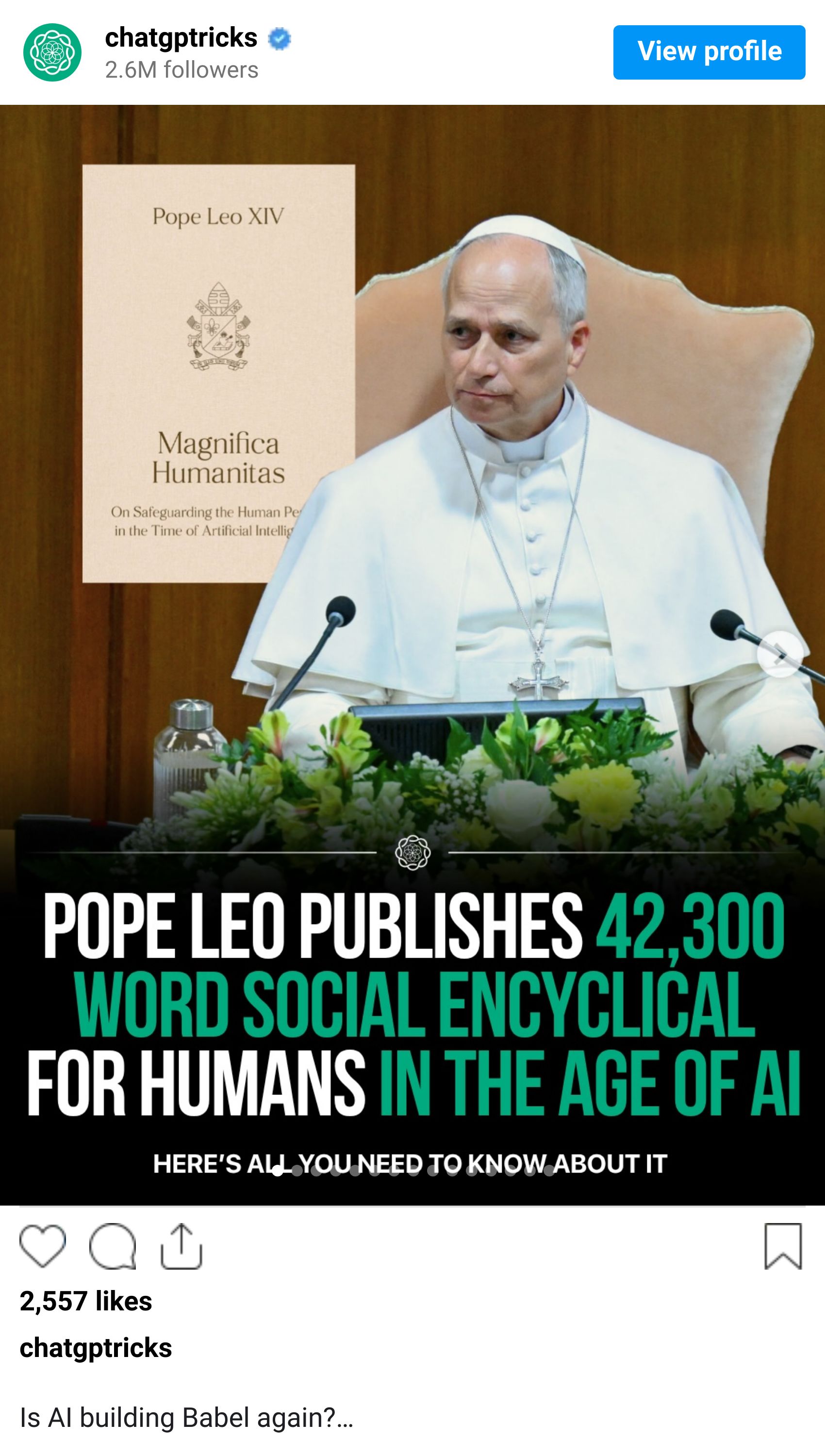
While the US and the UK were enjoying bank holidays, the Pope was busy. The Vatican has just given media companies a surprisingly useful AI strategy paper dressed as an encyclical.
The statement’s core idea is that technology must serve human dignity, the common good and truth, not merely efficiency, scale or profit.
Strip away the theology, and the message is a helpful moral road-map: in an age of synthetic content, machine-generated slop, and collapsing trust, the companies that win will be the ones that can prove they are still in the business of (expensive) verified human judgment.
For publishers, this is not a call to run away from AI. Quite the opposite. The useful lesson is to stop treating AI as either a transhumanist superpower or an existential threat to news organisations. Use it where it makes journalism better: archive search, transcription, translation, summarisation, fact checking and subscriber-facing answer engines. But keep humans firmly in the loop where judgment, style, accountability, empathy, soul and character are required.
The Vatican’s sharpest phrase for media is its call for an “ecology of communication”. AI chat interfaces are not neutral or passive. They shape reality. The mandate for media companies is to build systems that reward verified information, understanding, and clarity — not bias engines that drive outrage and dopamine.
There is also a very practical business opportunity here. As AI floods the web with infinite content, trusted brands, provenance and editorial restraint become more valuable, not less. I have argued before that publishers need to block unauthorised scraping, license high-quality content, build RAG products over their archives and lean into what it means to be human. That now looks less like a defensive posture and more like the emerging premium business model for media.
The statement is also a warning against the great flattening. AI can very easily turn publications into the same SEO-baiting, AI-slop machines. The Vatican’s “Babel” warning is really a warning against scale without soul: one language, one system, one machine logic, imposed everywhere. Media companies should use AI to strengthen local reporting (see Bristol Hana), surface neglected communities and obscure blogs. They should explain complexity and preserve distinctive editorial voices — not automate every article into the same bland, synthetic, low-calorie smoothie.
So the exec-level question is simple: does your AI strategy increase trust, or just increase output? The answer will show up in the product decisions: visible corrections, clear AI labelling, human oversight, clear attribution, (paid-for) provenance, and fact-checking that make people wiser rather than angrier.
In a world where anyone can generate words, images and video, the scarce commodity is not content. It is trusted editorial judgment and informed opinion.
In the spirit of ecclesiastical teaching, here are our cut and keep 10 Commandments for AI use in the newsroom:
The human journalist/ editor is always in charge of the bots and agents, which can always be turned off
Use only approved AI tools - permission rather than forgiveness
Verify every AI-assisted fact before publication - retain critical thinking
Use AI tools for support and research, but never publish AI-generated content in your name
Disclose AI use whenever it is deployed, even if used in the background
Respect copyright, fair use and intellectual property - always attribute source material
Do not fabricate or manipulate news images or videos with AI
Never enter private, personal or sensitive information into AI tools.
Challenge bias, misinformation and public harm before anything goes live.
Remain accountable for every error, correction and published decision.
Apocoloptimism
The augment vs replace debate is reaching peak doom (see last week’s newsletter). In that atmosphere, I gave a talk last week to the Mindstone community to pitch the positive, optimistic “augment” argument. By way of Joseph Schumpeter, William Jevons, Scott Galloway, Ezra Klein, and Alex Imas, I asked the audience to embrace the inevitable disruption and look for all the new opportunities already appearing. My presentation is here.


Mark Riley, CEO Mathison AI
For webinars, speaker engagements, workshops, and prototypes, email [email protected]

AI and Journalism
This week’s best articles, as chosen by HANA and our editors

NewsGuild-CWA Supports NY FAIR News Act to Regulate AI in Journalism Communications Workers of America - May 21, 2026 Members of The NewsGuild of New York, alongside labor allies, rallied in Albany to support the bipartisan NY FAIR News Act, which seeks to safeguard journalists and the public from AI misuse in news media. This legislation calls for transparency in AI usage by requiring news companies to inform employees and the public about AI-generated content, ensuring job protections and human oversight. |
FAQ: AI, misinformation and journalism Online Journalism Blog - May 23, 2026 The rise of AI-generated content poses significant challenges for journalism, complicating accurate reporting and undermining audience trust amid a flood of misinformation. As journalists adapt to these changes, the responsibility for maintaining content integrity lies not only with creators but also with technology companies, highlighting the need for public support and critical media literacy among consumers. |
New AI Safety Tool expands critical safety guidance for journalists and editors in the U.S. Cuny - Introducing JESS, an AI-powered tool from the Journalism Safety Institute designed to enhance journalists' access to crucial safety information and guidance. With real-time resources and tailored advice, JESS empowers reporters to navigate risks more effectively in the field, promoting their safety and well-being. |
How Indy newsrooms are using AI Poynter - The Indianapolis Public Editor project is a pilot initiative designed to evaluate the impact of having a public editor in news organisations, aiming to enhance transparency and trust between the media and its audience. By fostering open dialogue and addressing reader concerns, this project hopes to improve journalistic standards and inform future decisions about the role of public editors in journalism. |

Jane Kirtley on AI, Trump’s war on the press and the next generation of journalists MinnPost - May 21, 2026 Jane E. Kirtley, a distinguished expert on media law and the Silha Professor of Media Ethics and Law at the University of Minnesota, is retiring after a notable career marked by her advocacy for First Amendment rights and concerns about the current political climate's impact on independent journalism. In an insightful interview, she addresses the challenges facing the media industry, including the rise of AI, declining trust in mainstream outlets, and unprecedented regulatory actions that threaten free speech and journalistic integrity. |
Inside the news industry’s efforts to join forces to defend its journalism from AI companies Reuters Institute for the Study of Journalism - May 19, 2026 As AI tools reshape the information landscape, publishers are banding together to negotiate fair licensing agreements and protect their revenues, fearing a decline in website traffic due to user preference for AI-generated content. Initiatives like SPUR and the Danish Press Publications Collective Management Organisation are emerging to establish standards and frameworks that ensure journalists are compensated fairly while navigating the challenges posed by powerful AI companies. |

"AI shall not destroy journalism fundamentals," says IFJ General Secretary Ifj - May 19, 2026 Anthony Bellanger has called for urgent measures to protect journalism's core values from the potentially harmful effects of artificial intelligence, shifting the conversation from whether to embrace AI to how to safeguard journalistic integrity. His statement highlights the critical need for proactive strategies in response to the evolving media landscape influenced by technology. |

AI journalism licensing deals reshape media The European Magazine - May 22, 2026 AI companies are forging multi-million-dollar licensing agreements with major publishers, recognising the value of journalism content, yet concerns arise about whether smaller publications and freelance journalists can also benefit. As the landscape shifts, experts debate the implications for the industry, emphasising the need for continuous access to specialised content rather than one-off deals. |

Analysing AI's impact on media, communities and inequalities Vaticannews - May 21, 2026 In anticipation of Pope Leo XIV's encyclical "Magnifica humanitas," the Vatican's Dicastery for Communication hosted a conference on May 21, focusing on the impact of artificial intelligence on human dignity and society. Experts highlighted the importance of education, responsibility, and inclusivity in AI development to ensure it serves all communities and preserves the richness of human experience. |
Talk to your AI tools the way you'd talk to a colleague.

You don't send a colleague a three-word brief. You explain the context, the constraints, what you've already tried. But typing all that into ChatGPT takes forever — so you don't.
Wispr Flow lets you speak your prompts instead. Talk through your thinking naturally and get clean, paste-ready text. No filler words. No cleanup. Just detailed prompts that actually get you useful answers on the first try.
Millions of users worldwide. Works system-wide on Mac, Windows, and iPhone.
AI and Academic Publishing
This week’s best articles, as chosen by HANA and our editors

A key science publishing platform is cracking down on AI slop The Conversation - May 18, 2026 ArXiv has imposed a year-long ban on researchers whose papers contain errors generated by AI, aiming to combat the surge of low-quality, AI-generated submissions affecting scholarly standards. Critics suggest that instead of punitive measures, leveraging AI for enhancing peer review and quality assurance may be a more effective solution. |
The Matthew effect in AI summary - LSE Impact Lse - AI research tools risk perpetuating biases due to uneven representation in datasets, potentially sidelining underrepresented fields and reinforcing existing knowledge hierarchies. To foster innovation and diversity in scientific inquiry, researchers must prioritize equitable representation and diverse perspectives in their methodologies. |

Ban on Authors Who Submit AI Content “Welcome but Unenforceable” Inside Higher Ed | Higher Education News, Events and Jobs - May 22, 2026 arXiv has enacted a one-year ban on authors whose submissions include "hallucinated" references or misleading content generated by large language models, amid rising concerns over the integrity of AI-assisted research. While some scholars debate the severity of this penalty, the policy aims to uphold quality in scholarly communication while navigating the complexities of open access and verification. |

AI Is Not the Culprit First Things - May 21, 2026 In a thought-provoking exploration, the author reflects on the dual nature of AI chatbots in academia, viewing their rise as both a threat to creativity and an opportunity to liberate knowledge from institutional constraints. Ultimately, they argue that the real challenge lies within ourselves, advocating for a deeper spiritual connection and transformative grace rather than a rejection of technology. |

AI hallucinations in research, legal filings, and books are growing and getting harder to fix Fortune - May 24, 2026 A recent study highlights a troubling surge in fabricated references in biomedical literature, with incidents increasing over 12-fold as the use of AI tools like Topaz rises. This phenomenon poses significant risks to research integrity and underscores the urgent need for improved verification processes to combat the growing issue of AI-generated inaccuracies in critical fields such as healthcare, law, and journalism. |
Bloomsbury profits up 7% as AI licensing deal boosts academic division Register for free to access three articles a month and receive tailored newsletters about the book industry, or opt for a subscription starting at £3.65 per week for full access to exclusive content, including interviews and industry data. Join a vibrant community of professionals staying updated on the latest trends and news! |
This newsletter was partly curated and summarised by AI agents, who can make mistakes. Check all important information. For any issues or inaccuracies, please notify us here
View our AI Ethics Policy
